
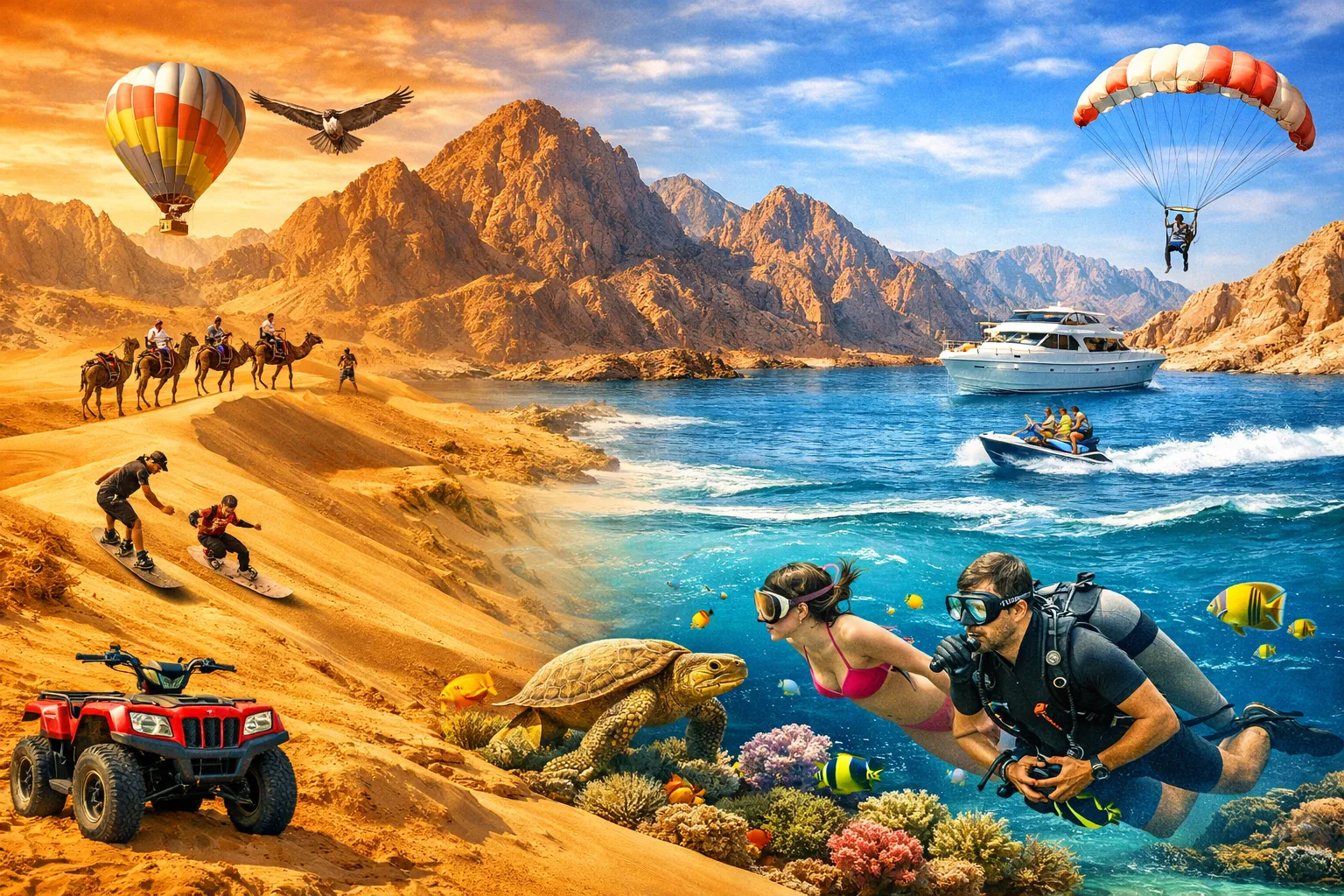
Sinai. For most travelers, the name conjures images of sun-drenched resort beaches, world-class diving along coral reefs, and cocktails at sunset. And yes — Sharm El Sheikh, Dahab, and Taba deliver all of that in spades. But there is another Sinai, one that few visitors ever experience: the Sinai of the interior.
Once you leave the coastal highway and head inland, the landscape transforms. The humidity lifts, the air grows dry and crystalline, and the horizon opens into a vast desert wilderness punctuated by jagged granite peaks. This is the Sinai of prophets and pilgrims, of Bedouin herders and ancient trade routes — a land that has remained largely unchanged for millennia.
The Colored Canyon: Nature's Kaleidoscope
About 90 minutes northwest of Dahab, near the town of Nuweiba, lies one of Sinai's most spectacular natural wonders: the Colored Canyon. Despite its name, this geological masterpiece is far more than just colorful — it is a surreal labyrinth of sandstone formations that seem to belong to another planet.
The canyon was formed over millions of years as water eroded through layers of mineral-rich sandstone, creating narrow passageways that rarely exceed two meters in width while the walls tower up to 40 meters above. The minerals — iron oxides, manganese, copper, and magnesium — have painted the rock faces in swirling bands of deep red, ochre, gold, purple, and even turquoise.
"Walking through the Colored Canyon feels like stepping inside a geode. The walls close in around you, and the light filters down from above, illuminating the rock in shades you didn't know existed in nature."
Visitors typically spend 2-3 hours exploring the canyon. A local Bedouin guide is highly recommended — not just for navigation, but because they know the side canyons and hidden chambers that most tourists never see. The best time to visit is early morning (8-10 AM) or late afternoon (3-5 PM), when the low angle of the sun brings out the full spectrum of colors.
St. Catherine's Monastery: Where Heaven Meets Earth
Nestled at the foot of Mount Sinai in a dramatic mountain basin at 1,600 meters elevation, St. Catherine's Monastery is one of the oldest continuously operating monasteries in the world. Founded in the 6th century by Emperor Justinian, it has been a pilgrimage destination for Christians, Muslims, and Jews alike for over 1,400 years.
What makes St. Catherine's truly remarkable is not just its age, but its living heritage. The monastery houses:
- The Burning Bush — believed to be the very bush from which God spoke to Moses, and one of the oldest known specimens of its species
- The Library — second only to the Vatican in its collection of ancient manuscripts and icons, with over 6,000 volumes including some of the earliest copies of the Gospels
- The Church of the Transfiguration — a 6th-century basilica with stunning mosaic work and icons spanning fourteen centuries
- The Chapel of the Burning Bush — built on the spot where Moses is said to have received the Ten Commandments
For the full experience, begin your visit before dawn with the ascent of Mount Sinai (Gebel Musa). The hike takes 2-3 hours via the "Steps of Repentance" — a steep staircase of over 3,700 steps carved by monks into the mountainside. Reach the summit in time for sunrise, when the first light paints the surrounding peaks in gold and amber, and the entire Gulf of Aqaba stretches out to the horizon. It is, without exaggeration, one of the most moving sunrise experiences on Earth.
Ras Muhammad National Park: Where Deserts Meet the Sea
At the southernmost tip of the Sinai Peninsula, where the Gulf of Suez meets the Gulf of Aqaba, lies Ras Muhammad National Park. While technically a coastal destination, its unique geology — where desert dunes plunge directly into coral-fringed waters — makes it a fitting bridge between Sinai's two worlds.
The park is primarily known for its world-class dive sites, including Shark Observatory and Yolanda Reef, but above-water attractions are equally compelling:
- The Magic Lake — a saltwater lake with extraordinary buoyancy, surrounded by desert
- The Earthquake Fissure — a dramatic crack in the earth that reveals the region's tectonic activity
- The Mangrove Channel — one of the northernmost mangrove forests in the world, vital for migratory birds
- The Viewpoint at the Confluence — where you can literally see the two gulfs meeting, their waters a different shade on each side
Wadi Feiran: Sinai's Green Paradise
Known as the "Pearl of Sinai," Wadi Feiran is the largest and most fertile wadi (valley) on the peninsula. Located about 45 kilometers northwest of St. Catherine's, this lush oasis supports a thriving community of Bedouin farmers who cultivate date palms, olive trees, and pomegranates in the shade of towering palm groves.
The wadi has been inhabited since antiquity — archaeological evidence suggests continuous settlement for over 4,000 years. It was an important stop on the ancient trade route between Egypt and the Levant, and later became a center of early Christian monasticism. The ruins of the Monastery of the Forty Martyrs still stand as a testament to this heritage.
Today, visitors can hike through the wadi, swim in natural rock pools fed by mountain springs, and share tea with Bedouin families who have called this valley home for generations. It is a world away from the resort strip, yet only two hours by car from Sharm El Sheikh.
Serabit el-Khadim: The Pharaohs' Turquoise Mines
Deep in the southwestern Sinai desert, an hour's drive from the coastal town of Abu Zenima, lies Serabit el-Khadim — one of the most significant archaeological sites in the peninsula. This was the ancient Egyptians' primary source of turquoise, a gemstone prized by the pharaohs for its celestial blue-green color.
The site features:
- The Temple of Hathor — the only pharaonic temple in Sinai, dedicated to the goddess of turquoise, mining, and beauty. Built incrementally from the 12th to the 20th Dynasty, it contains inscriptions from some of Egypt's most famous rulers, including Amenhotep III, Ramesses II, and Thutmose III.
- Proto-Sinaitic inscriptions — carved into the rock walls by Canaanite miners around 1800 BCE, these are among the earliest examples of alphabetic writing in human history. The Proto-Sinaitic script is the direct ancestor of the Phoenician, Greek, and ultimately Latin alphabets we use today.
- Extensive mining galleries — tunnel networks that penetrate deep into the mountain, showing the incredible scale of ancient mining operations
Serabit el-Khadim receives very few visitors due to its remote location and the rough desert track required to reach it. This makes it all the more rewarding for those who make the journey.
Bedouin Hospitality: The Soul of Sinai
No exploration of Sinai's interior is complete without experiencing Bedouin hospitality. The Bedouin (from the Arabic badawi, meaning "desert dweller") have inhabited Sinai for over 2,000 years, and their culture is inseparable from the landscape itself.
Stopping at a Bedouin camp — even a small one — is an experience that stays with you. You will be greeted with the ritual of Arabic coffee (bitter cardamom-spiced coffee) or shay bil-na'na' (sweet mint tea), served in small glasses with ceremony and warmth. The traditional meal of Zarb — meat and vegetables slow-cooked in an underground sand oven — is the desert equivalent of a feast, and sharing it under a canopy of stars with new friends is the essence of Sinai.
Many Bedouin communities now offer eco-desert camps where visitors can stay overnight in goat-hair tents, learn about traditional weaving and bread-making, and trek by camel or on foot through some of the most pristine desert landscapes on the planet.
Practical Tips for Your Inland Adventure
- Best time to visit: October through April, when temperatures are comfortable for hiking (20-28°C). Summer months (May-September) are extremely hot inland, especially in the canyons and open desert.
- What to bring: Sun protection (hat, sunscreen, sunglasses), at least 2 liters of water per person, sturdy walking shoes, a warm layer for evenings (desert temperatures drop significantly after sunset), and a headlamp or flashlight.
- Getting around: A 4x4 vehicle is recommended for most inland destinations. Many tour operators in Sharm El Sheikh, Dahab, and Nuweiba offer guided day trips and multi-day expeditions.
- Respect local customs: Dress modestly when visiting St. Catherine's Monastery and Bedouin communities. Always ask permission before photographing people.
- Guides: A local Bedouin guide is invaluable for destinations like the Colored Canyon and Serabit el-Khadim. They know the terrain, the history, and the hidden spots that make each place special.
The Real Sinai Awaits
The Sinai Peninsula is far more than its coastline. It is a land of profound beauty and deep history — where the geological and the spiritual converge, where ancient traditions coexist with the modern world, and where every canyon, peak, and oasis tells a story.
The resorts will always be there. But the real Sinai — the one that changes how you see the world — is inland, waiting for those who venture beyond the beach.